Medical Credentialing Services for Providers | Provider Enrollment Experts
Get faster approvals with our expert medical credentialing services for providers. We offer complete provider enrollment and credentialing support, helping physicians, group practices, and clinics get credentialed with Medicare, Medicaid, and commercial insurance payers. Our team manages CAQH, PECOS, and payer applications with accuracy, ensuring compliant submissions across the United States. We streamline the entire credentialing process to eliminate bottlenecks from application preparation through final enrollment approval.
Medical Credentialing Services We Offer
We offer credentialing services to providers, managing every step of the provider enrollment and credentialing process across Medicare, Medicaid, and commercial insurance payers. Our team ensures accurate submissions, proactive follow-ups, and continuous compliance so your practice gets credentialed faster and stays in-network without disruption.
We create, optimize, and maintain your CAQH profile to ensure all provider data is accurate, complete, and regularly attested. Our team manages document uploads, discrepancy corrections, and ongoing updates so insurance payers can access verified information for quick credentialing approvals.
We handle Medicare provider enrollment through PECOS, ensuring your application meets all CMS requirements. From initial setup to revalidation, our Medicare credentialing team focus on reducing delays due to incomplete documentation, thus securing approvals for individual and group providers.
Our team manages Medicaid credentialing based on state-specific requirements, ensuring accurate application submissions, documentation compliance, and proper follow-up with state payers. We help providers navigate varying enrollment rules to avoid delays and maintain continuous participation.
We assist with NPI registration for individual providers and organizations, ensuring correct setup for billing, credentialing, and payer enrollment. Our team ensures your NPI information aligns with CAQH and payer records to prevent processing issues and delayed approvals.
Who Needs Medical Credentialing Services?
We support individual practitioners, group practices, and healthcare organizations and offer credentialing support that ensure physicians are properly enrolled with Medicare, Medicaid, and commercial insurance networks while maintaining compliance and billing readiness.
Individual Providers & Private Practices
We provide complete physician insurance credentialing and enrollment support to solo providers, including therapists, nurse practitioners, and specialists.Group Practices & Clinics
Our provider enrollment services support multi-specialty groups with medical practice credentialing across multiple payers.Behavioral Health Providers
We specialize in credentialing for mental health providers, including therapists, psychologists, psychiatrists, and ABA providers.Telemedicine
We assist telehealth and multi-state practices, ensuring compliance with licensing requirements, payer rules, and cross-state enrollment processes.New Providers & Startups
We assist new providers with NPI registration, CAQH profile creation, and insurance panel enrollment.
Submitting claims before credentialing approval can result in denied claims and lost revenue. Read our guide on what happens if you bill before credentialing approval.
Not sure where to start?
Schedule a free consultation with a credentialing expert and build your roadmap to get started.
Our Medical Credentialing Process
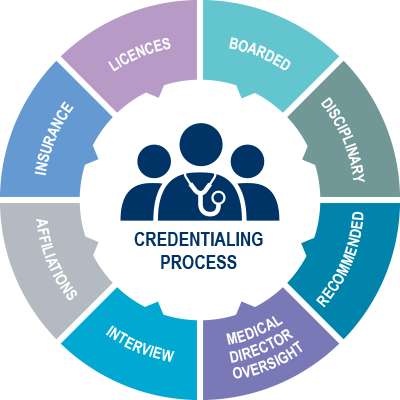
We manage every step of the credentialing process—from initial data collection to final approval.
Step 1: Provider Information & Document Collection
We collect and verify all required provider information, including NPI details, licenses, DEA certificates, malpractice insurance, and supporting documentation.
Step 2: CAQH Profile Setup & Verification
We create or update your CAQH profile, ensuring all provider data is accurate, complete, and properly attested.
Step 3: Provider Enrollment & Application Submission
We submit applications for provider enrollment services across insurance payers. Each submission is reviewed for accuracy and compliance.
Step 4: Payer Follow-Up & Status Tracking
We actively follow up with insurance payers to monitor application status, and respond to additional requests.
Step 5: Approval, Activation & Billing Readiness
Once approved, we confirm your network participation, ensure your provider information is active in payer systems, and verify that your practice is ready to begin billing.
For Medical Insurance Credentialing Services
Authorities For Credentialing And Re-credentialing
The insurance credentialing process for healthcare providers typically involves several key authorities and organizations that set standards and ensure compliance. These include:
- National Provider Identifier (NPI) Registry – The NPI Registry is an essential database for identifying healthcare providers. Every provider must obtain an NPI, to bill insurance and get credentialed.
- The American Board of Medical Specialties (ABMS) – The ABMS certifies physicians in the United States in different medical specialties and sub-specialties. Board certification is a critical part of the credentialing process for physicians. Insurance companies often require board certification from ABMS-accredited boards as part of their credentialing criteria.
- The Joint Commission (TJC) – The Joint Commission is a nationally recognized organization that accredits healthcare organizations and programs. It also plays a role in credentialing with insurance by ensuring healthcare facilities meet strict standards for patient care and safety.
- National Committee for Quality Assurance (NCQA) – The NCQA is responsible for accrediting healthcare organizations and also works closely with insurance companies to ensure providers meet high standards. It has specific standards for credentialing and recredentialing providers within health plans.
- State Medical Boards – Each state has its own medical board responsible for licensing and credentialing physicians within the state. These boards are responsible for verifying licensure and monitoring the credentialing process to ensure that doctors meet state-specific requirements to practice medicine.
- Council for Affordable Quality Healthcare (CAQH) – CAQH offers a centralized platform for healthcare providers to submit their credentialing information to multiple insurance companies and healthcare organizations. Many insurance companies require that providers complete credentialing through CAQH as part of the credentialing process for providers.
- Centers for Medicare & Medicaid Services (CMS) – For providers who wish to participate in the Medicare and Medicaid programs, CMS manages the Medicare Provider Enrollment, Chain, and Ownership System (PECOS), which is used to verify and enroll providers. CMS also plays a role in recredentialing providers for continued participation in these programs.




Provider Enrollment and Credentialing Timelines
| Type of Credentialing | Average Timeline |
|---|---|
| Initial Credentialing | 90–120 Days |
| Re-Credentialing | 60–90 Days |
| Medicare (PECOS) Enrollment | 45–90 Days |
| Medicaid Enrollment | Varies by State |
| Enrollment with Commercial Payers | 30-60 Days |
| CAQH Profile Verification | 7–14 Days |
Pro Tip: Start the credentialing process at least 90–120 days before your planned start date to avoid interruptions in billing and reimbursement.
Medicare & Medicaid Credentialing Support
As part of our insurance credentialing services, we support Medicare and Medicaid enrollment by managing PECOS applications, state-specific Medicaid requirements, and payer communications. Our team ensures accurate submissions, compliance with CMS guidelines, and proactive follow-ups to get provider enrolled in time.
For providers looking for dedicated enrollment support, explore our Medicare credentialing services.
Cost of Delayed Credentialing
Delays in credentialing don’t just affect timelines—they directly impact your revenue, cash flow, and overall practice performance. When providers are not properly enrolled, services may go unreimbursed, leading to financial losses that cannot always be recovered.
- When credentialing is delayed, providers may continue seeing patients but remain unable to bill insurance. This can result in weeks or months of unreimbursed services, significantly affecting practice income.
- Even a short delay can create substantial losses. For example, a provider seeing 15–20 patients per day with an average reimbursement of $80–$120 per visit can lose thousands in potential revenue over a few weeks of delayed enrollment.
- Billing without proper credentialing or with incomplete enrollment often leads to claim denials or rejections. These claims require additional time and resources to correct—and in many cases, they are not recoverable.
- Credentialing delays can interrupt the steady flow of reimbursements, making it difficult for practices to manage operational costs such as payroll, rent, and administrative expenses.
- Without a structured credentialing process, staff must spend additional time tracking applications, responding to payer requests, and resolving issues—diverting focus from patient care and core operations.
How MedStates Streamlines Medical Insurance Credentialing
At MedStates, we focus on delivering consistent, predictable credentialing outcomes—not just submissions. As one of the established healthcare credentialing companies with over 9 years of experience, our approach reduces approval delays, minimizes rework, and ensures providers are enrolled correctly the first time with the appropriate taxonomy aligned to their license and practice setting. We bring deep experience across Medicare, Medicaid, and commercial payers nationwide, taking full ownership of the process with accuracy, accountability, and continuous follow-up. This ensures providers are approved on time, properly linked to payer systems, and ready to bill.
Case Study: Faster Credentialing for a Multi-Specialty Clinic
A multi-specialty outpatient clinic in Ohio with 18 providers, struggled with frequent delays in credentialing new providers with major commercial insurers. Their in-house administrative team lacked the capacity to manage re-credentialing and follow-ups effectively, resulting in recurring claim denials and significant disruptions to their revenue cycle.
MedStates Solution:
We took over the full credentialing and enrollment process, including:
- Complete audit and update of all provider CAQH and NPI profiles
- Direct communication with payers like BCBS, UHC, Cigna, and Medicare
- Setup of automated reminders for re-credentialing
- Transparent progress tracking via MedStates dashboard
Results (within 3 months):
- Credentialing approval time reduced by 42%
- Eliminated $18,700/month in claim denials due to enrollment gaps
- Re-credentialing compliance improved to 100%
- Clinic administrator reported a 60% reduction in credentialing workload
Frequently Asked Questions
What is provider credentialing, and why is it important?
Provider credentialing verifies a provider’s qualifications, licenses, and professional history. It is essential for joining insurance networks, maintaining compliance, and receiving reimbursements from insurance payers.
Is credentialing necessary to bill insurance?
Yes. Providers must complete credentialing and enrollment before billing insurance. Without approval, claims are typically denied or rejected, and services may not be reimbursed.
How long does the credentialing process take?
Credentialing usually takes 90–120 days. Timelines vary based on payer requirements, application accuracy, and response time to additional documentation requests.
What documents are required for credentialing?
Common documents include a medical license, DEA certificate, board certifications, malpractice insurance, NPI, CAQH profile, and W-9 form.
What is Council for Affordable Quality Healthcare (CAQH)?
CAQH is a centralized database used by insurance payers to access and verify provider credentialing information. Providers must maintain updated profiles for enrollment and re-credentialing.
Why is board certification important for credentialing?
Board certification confirms a provider meets professional standards in their specialty. Many insurance payers require it for credentialing and network participation.
What are common reasons for credentialing denials?
Denials often result from incomplete applications, outdated documents, inconsistent information across systems, or lack of follow-up with insurance payers.
Can you help with CAQH profile setup and maintenance?
Yes. We manage CAQH profile setup, document uploads, updates, and attestations to ensure accurate and timely credentialing.
Do you offer medical credentialing services for all specialties?
Yes. We support credentialing for multiple specialties, including primary care, behavioral health, and multi-provider practices, across various insurance networks.
Do you provide recredentialing services as well?
Yes. We track deadlines, manage updates, and handle re-credentialing requirements to ensure continuous enrollment and avoid billing disruptions.
How do credentialing services benefit my practice?
Credentialing services reduce administrative workload, improve application accuracy, speed up approvals, and help prevent claim denials, supporting a stable revenue cycle.
How much do your medical credentialing services cost?
Costs vary based on the number of providers, payers, and services required. Get your quote now!